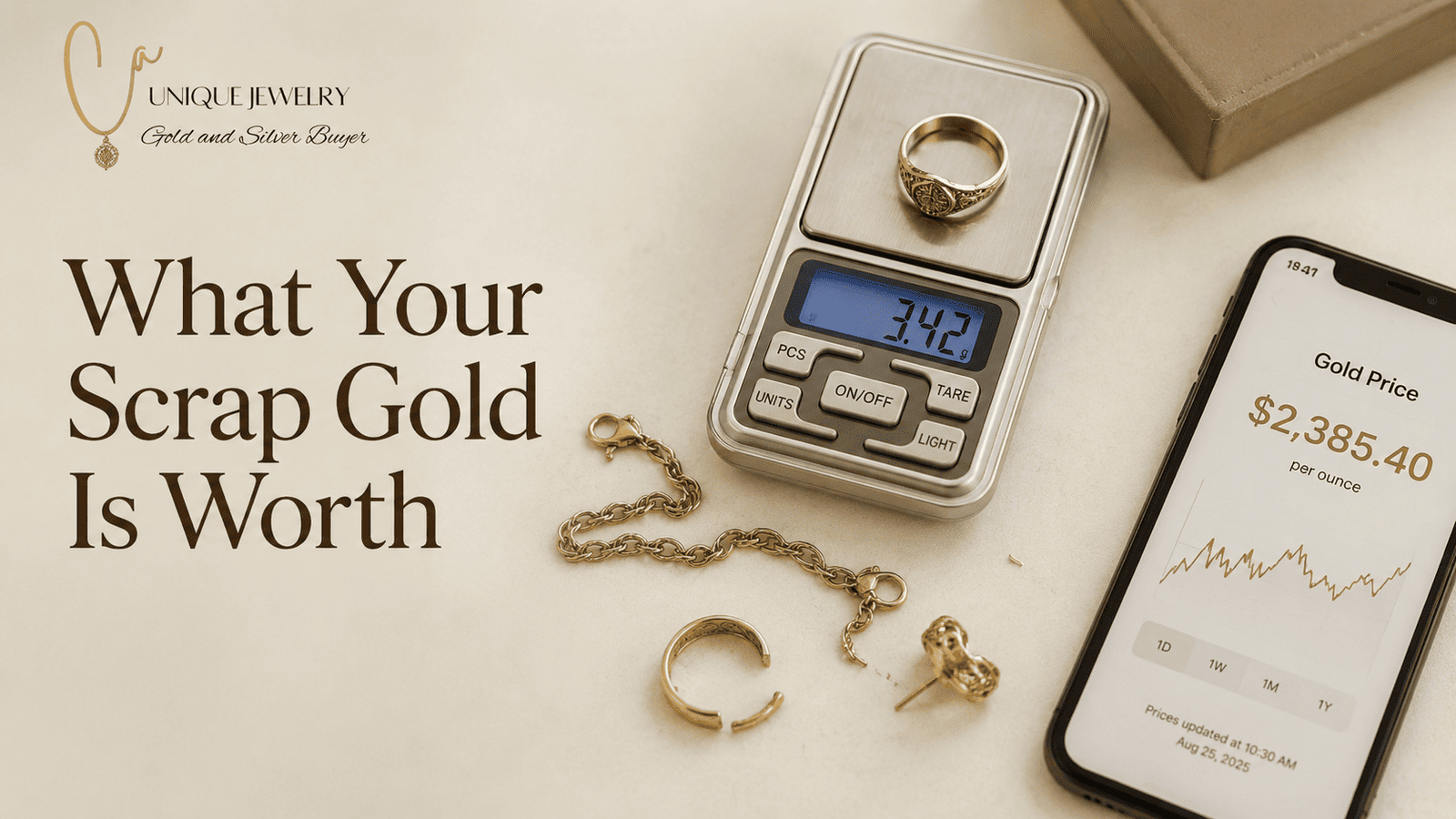
What Your Scrap Gold Is Worth and How the Number Is Reached
Scrap gold is worth the value of the pure gold inside it, calculated from three things: its karat purity, its weight, and the gold price on the day you sell. That is the whole formula, and once you understand it, no offer can catch you off guard.
Most people who sell old jewelry have no idea how the final number is reached. They hand over a broken chain, hear a figure, and take it on trust. Knowing how the math works puts you in a far stronger position at the counter.
This guide shows exactly how a buyer calculates what your scrap gold is worth, with a real dollar example, so you can check any offer against the numbers yourself.
Quick Summary
Scrap gold worth is based on purity times weight times the daily gold price, then a buyer margin is applied. A fair buyer pays 70 to 85 percent of the melt value. Knowing your karat and weight before you sell lets you judge any offer on the spot.
What Counts as Scrap Gold
Scrap gold is any gold sold for its metal content rather than its form. What that scrap gold is worth depends on the metal inside it, not the piece’s condition or style.
That includes broken chains, single earrings, bent rings, outdated jewelry, and dental gold. A snapped 14k bracelet is worth exactly the same per gram as an intact one, because a buyer values the metal, not the shape. This is why there is no reason to repair a piece before selling it as scrap.
The Three Numbers Behind What Scrap Gold Is Worth
Every scrap gold payout comes from the same three inputs. Get these, and you can estimate any piece.
Karat purity. Gold jewelry is rarely pure. Karat tells you the percentage of actual gold, from 10k at 41.7 percent up to 24k at 99.9 percent.
Weight in grams. Gold is priced by the gram. More weight means more gold, as long as the purity is the same.
The daily gold price. The spot price of gold changes every trading day, and it sets the baseline value for the metal.
| Karat | Gold Purity | Common Use |
| 10k | 41.7% | Budget jewelry |
| 14k | 58.3% | Most US jewelry |
| 18k | 75.0% | Fine jewelry |
| 22k | 91.6% | Asian gold |
| 24k | 99.9% | Bars and coins |
Understanding what your gold jewelry is made of is the starting point for any estimate.
How to Calculate Your Gold Jewelry Value Step by Step
Here is the formula buyers use, broken into plain steps. A guide to melt values and how they are priced follows the same logic.
Step 1: Find the pure gold price per gram. The gold spot price is quoted per troy ounce, and one troy ounce is about 31.1 grams. Divide the spot price by 31.1.
Step 2: Multiply by your karat purity. Take that per-gram figure and multiply by the purity percentage of your piece.
Step 3: Multiply by the weight. Multiply the result by the weight of your piece in grams. That gives you the melt value.
Step 4: Apply the buyer margin. The buyer pays a percentage of the melt value, which covers testing, refining, and running the business.
A Real Example: What a 14k Chain Is Worth
Numbers make this clear. Say you have a 14k gold chain weighing 20 grams, and gold is trading at $2,400 per troy ounce.
| Step | Calculation | Result |
| Price per gram (pure) | $2,400 ÷ 31.1 | About $77 |
| Adjust for 14k purity | $77 × 58.3% | About $45 per gram |
| Multiply by weight | $45 × 20 grams | $900 melt value |
| Apply 75% buyer margin | $900 × 0.75 | $675 payout |
So a 20-gram 14k chain in this example is worth about $675 in the hand. The melt value is $900, and the payout is a fair share of it. Seeing how a buyer runs this same valuation process in front of you is the sign of an honest transaction.
What a Fair Buyer Margin Looks Like
The margin is where fair and unfair buyers separate. Everything else that decides what your scrap gold is worth is fixed by the market.
A fair gold buyer pays 70 to 85 percent of the melt value. A margin down near 40 to 60 percent is low, and worth walking away from. On the $900 melt value above, a fair payout runs roughly $630 to $765, while a lowball offer might sit near $450.
Details on scrap gold value confirm that transparency on this margin is the clearest sign of a trustworthy buyer. If a buyer will not show you the spot price and the math, that is your signal to ask more questions or leave.
What Affects Your Final Payout
A few things can move your payout up or down beyond the basic formula.
- Mixed karats weighed together. A buyer who lumps 10k and 18k into one weight prices it all at the lower rate. Sort your pieces by karat first.
- Stones and non-gold parts. Clasps, settings, and gemstones add weight that is not gold, and a buyer deducts for them.
- Testing method. A reputable buyer confirms purity with an acid test or an electronic scanner, so you are paid for the real karat, not a guess.
- The day you sell. Since the gold price moves daily, timing affects the number. Checking the price before you go gives you a baseline.
How to Get the Most for Your Scrap Gold
A little preparation protects your payout and makes the sale faster.
Know your karat by reading the stamps inside each piece. Check the day’s gold price so you have a baseline. Separate your pieces by karat so nothing is averaged down. And get more than one offer if the amount is significant, since a fair buyer welcomes the comparison. Walking in prepared is what turns a fair offer into a confident sale.
Conclusion
What your scrap gold is worth is never a mystery once you know the formula. Purity times weight times the daily gold price gives you the melt value, and a fair buyer pays 70 to 85 percent of it. Run the numbers before you sell, and every offer becomes easy to judge.
The difference between a good sale and a poor one usually comes down to preparation. Know your karat, check the price, sort your pieces, and choose a buyer who shows you the math instead of hiding it.
If you are in central Arkansas and ready to turn old gold into cash, you can sell your gold at Unique Jewelry with open testing and live pricing. To ask about a specific piece or confirm current rates first, reach out through the contact page, and the team will walk you through it.
Mudassir Ali Jewelry & Precious Metals Writer
Mudassir Ali writes about precious metals, gold markets, and jewelry valuation for independent buyers and jewelers across the United States.
FAQs
How is scrap gold value calculated?
Scrap gold value comes from three numbers: the karat purity, the weight in grams, and the daily gold price. A buyer multiplies these to find the melt value, then pays a percentage of it. A fair buyer pays 70 to 85 percent of that melt value.
How much is 14k scrap gold worth per gram?
It depends on the gold price that day. At a $2,400 spot price, 14k gold holds about $45 of pure gold per gram. A fair buyer then pays 70 to 85 percent of that, so roughly $32 to $38 per gram. To confirm a current figure, call Unique Jewelry at +1 (501) 859-1282.
Does broken or damaged gold sell for less?
No. Scrap gold is priced on metal content, not condition. A broken chain pays the same per gram as an intact one, so there is no reason to repair a piece before selling it as scrap.
What percentage of melt value should a gold buyer pay?
A fair buyer pays 70 to 85 percent of the melt value. Anything near 40 to 60 percent is low. The margin covers testing, refining, and business costs, but a transparent buyer will show you exactly how they reached the number.
Do gemstones add to my scrap gold payout?
Not to the gold value. A gold buyer prices the metal, and stones add weight that is not gold, so they are deducted. If a piece has valuable stones, have them assessed separately rather than sold as part of a scrap lot.
How can I get the most for my scrap gold?
Know your karat, check the day’s gold price, and sort pieces by karat so nothing is averaged down. Get more than one offer if the amount is significant, and choose a buyer who tests openly and shows the calculation.