How to Prep Your Gold Jewelry Before Selling It
Walking into a sale with unsorted, unknown gold puts you at a disadvantage. You have no idea what the pieces weigh, what karat they are, or what a fair number looks like. That gap is exactly where sellers lose money.
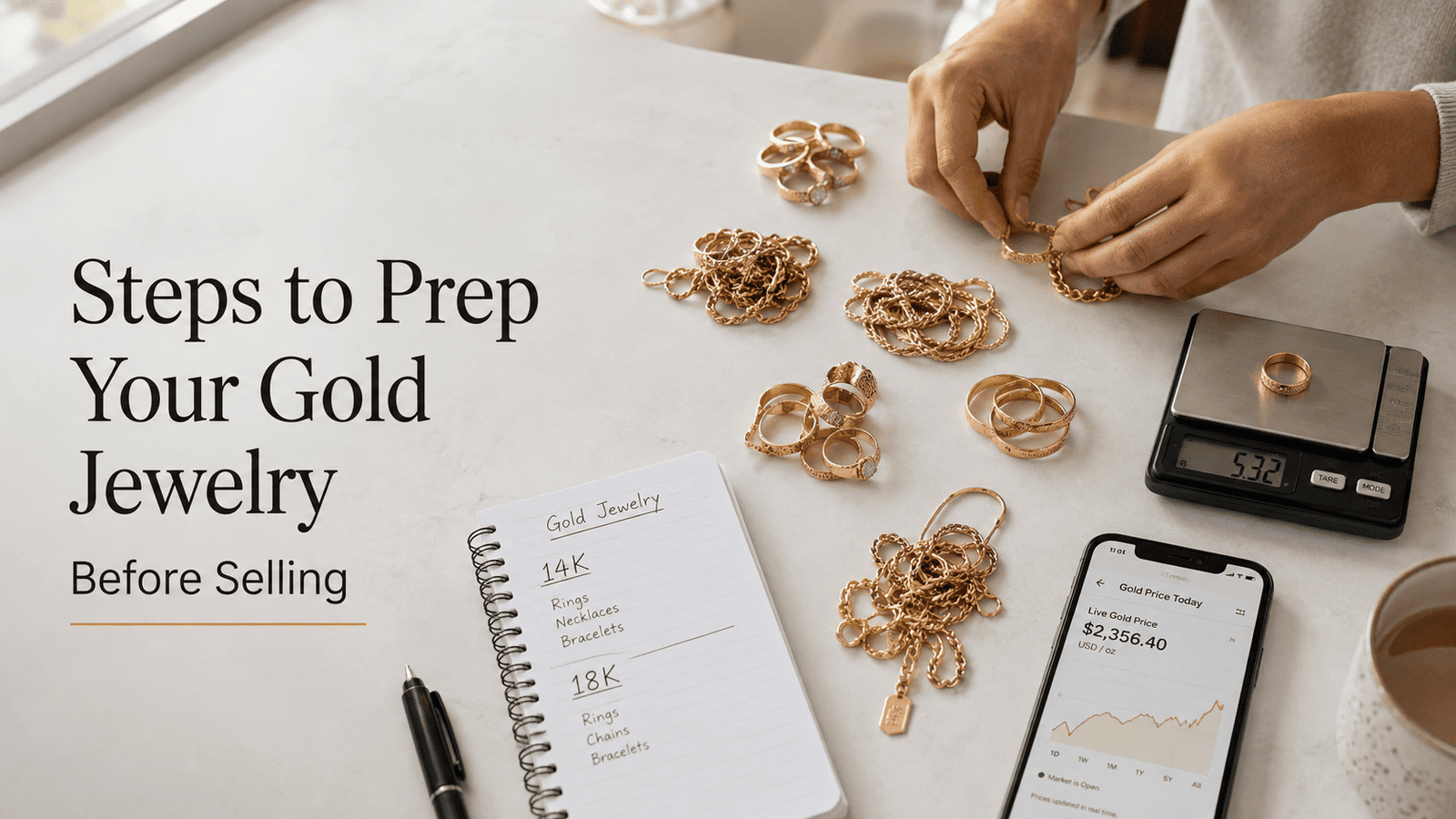
A little prep fixes that. Thirty minutes at your kitchen table tells you roughly what you own and what it should fetch, so you can spot a low offer the second you hear it. Here is how to get your gold jewelry ready before selling, step by step.
Why Prep Matters More Than People Think
Gold buyers price your jewelry on three numbers: purity, weight, and the gold price that day. You can check all three at home before anyone makes you an offer.
Sellers who skip this walk in blind. They accept whatever number they hear because they have nothing to compare it to. Sellers who prep walk in with a range in mind and negotiate from there. Same gold, different outcome.
Prep does not require special tools or expertise. It requires a scale, good light, and a few minutes per piece. A practical rundown on preparing gold jewelry for sale reaches the same conclusion: the sellers who prepare do better than the ones who wing it.
Step 1: Sort Your Pieces by Type and Karat
Start by spreading everything out and grouping it. Keep gold with gold, and within that, separate by karat.
Why karat matters: an 18k ring is 75 percent pure gold, while a 10k ring is only 41.7 percent. If a buyer weighs them together, the whole lot often gets priced at the lower rate. Sorting protects the higher-karat pieces.
Make these piles:
- By metal: gold, silver, platinum, and anything you are unsure about
- By karat: 10k, 14k, 18k, 22k, 24k
- By type: solid gold versus plated or filled (more on spotting the difference below)
- Set aside: anything with large stones, a designer mark, or an antique look
That last pile matters. Those pieces may be worth more whole than melted, so you want them judged separately.
Step 2: Find and Read the Karat Marks
Almost all real gold jewelry carries a tiny stamp showing its purity. Look inside ring bands, on necklace clasps, on the posts of earrings, and on the underside of pendants. A jeweler’s loupe or your phone camera on zoom helps.
You will see one of two marking systems.
| Karat Mark | Numeric Mark | Gold Purity | Common Use |
| 10K | 417 | 41.7% | Budget rings, chains |
| 14K | 585 | 58.3% | Most US jewelry |
| 18K | 750 | 75.0% | Fine jewelry |
| 22K | 916 | 91.6% | Asian and Middle Eastern gold |
| 24K | 999 | 99.9% | Bars, some coins |
Other stamps tell you what is not solid gold:
- GP, GEP, HGE: gold plated, a thin layer over base metal
- GF or 1/20 14K GF: gold filled, more gold than plating but still not solid
- 925: sterling silver, not gold at all
Plated and filled pieces hold almost no melt value. Knowing this before you go stops a buyer from paying you solid-gold prices in your head that never materialize. If a mark is worn off or you cannot find one, a proper acid or electronic test settles it. Reading antique gold hallmarks helps with older or foreign pieces that use unfamiliar stamps.
Step 3: Weigh Everything at Home
Weight drives the payout, so knowing it in advance is your strongest bargaining chip.
A small digital scale that measures in grams costs about ten dollars. Kitchen scales work if they read to 0.1 gram. Jewelers price gold by the gram, so grams are the unit you want. A step-by-step guide to weighing gold correctly covers the small details that trip people up.
How to do it:
- Turn on the scale and let it zero out
- Weigh each karat pile separately, not all together
- Write down the weight next to the karat for each pile
- Keep pieces with stones apart, since the stone adds weight that is not gold
One caution: stones, clasps, and any non-gold parts inflate the number. A ring with a big cubic zirconia weighs more than its gold content. Buyers deduct for that, so treat your home weight as a ceiling, not a promise.
Step 4: Check the Day’s Gold Price
Gold trades at a price that moves every day, sometimes every hour. That price, the spot price, sets the baseline for every offer.
The spot is quoted per troy ounce. One troy ounce equals 31.1 grams. To get a rough per-gram melt value for a piece:
Per-gram pure gold value = spot price ÷ 31.1
Then multiply by the purity and the weight:
Melt value = per-gram value × karat purity × grams
Quick example at a $2,400 spot price:
- $2,400 ÷ 31.1 = about $77 per gram of pure gold
- A 10-gram 14k chain is 58.3 percent gold
- 10 × 0.583 × $77 = about $449 in melt value
That $449 is the raw metal value. A buyer pays a percentage of it, not the whole thing, because they need a margin to run the business and refine the gold.
Step 5: Know What a Fair Offer Looks Like
Here is the part most guides skip. Knowing your melt value is only half the picture. You also need to know what share of it a fair buyer pays.
| Offer as % of Melt Value | What It Means |
| 85–95% | Excellent, usually large or bulk lots |
| 70–85% | Fair, the range to aim for |
| 55–70% | Below average, worth comparing elsewhere |
| Under 55% | Low, walk away |
On that $449 chain, a fair offer sits somewhere between about $314 and $382. If someone offers you $200, you now know to leave. Without prep, that $200 might have sounded reasonable.
The gold valuation process at a transparent buyer shows you each of these numbers instead of hiding them, which is the clearest sign you are dealing with someone honest.
Step 6: Gather Documents and Set Aside Special Pieces
Most scrap gold needs no paperwork. But a few things help for specific pieces:
- Receipts or certificates for designer or gem-set jewelry, which prove authenticity and can lift the price
- A photo ID, which any licensed buyer must record by law before purchase
- Appraisals, useful as reference, though they reflect retail replacement value, not melt
Pull out anything that might beat melt value. A signed Cartier piece, a diamond of real size, or a genuine antique can sell for more intact than melted. Those deserve a specialist look. Broken chains, single earrings, and bent rings, on the other hand, are pure scrap and priced by weight alone. A broken gold jewelry selling guide covers how damaged pieces are handled.
Step 7: Test Questionable Pieces (Optional)
If you are not sure a piece is real gold, a few at-home checks give hints before a professional confirms it.
- Magnet test: gold is not magnetic. If a piece pulls to a strong magnet, it is not solid gold. Passing this test does not prove gold, though, since other non-magnetic metals exist.
- Skin test: rub the piece on clean skin. Real gold rarely leaves a black or green mark. Reactions often point to plating.
- The stamp: the karat mark remains the most reliable quick signal, which is why Step 2 matters.
These are screens, not proof. A set of at-home tests to check gold can narrow things down, but an acid test or an electronic tester at a jeweler gives the real answer, and most buyers do it free while you watch.
A Simple Pre-Sale Checklist
Run through this before you head out the door.
- Sorted pieces by metal and karat
- Found and recorded every karat mark
- Separated plated and filled pieces from solid gold
- Weighed each karat pile in grams
- Checked the day’s spot price
- Calculated a rough melt value per pile
- Set a fair-offer range (70–85% of melt)
- Pulled out designer, gem-set, and antique pieces for separate judging
- Grabbed a photo ID and any receipts
Ten minutes of this changes how the whole sale goes. You stop being a passenger and start being someone who knows the numbers.
If you are weighing your options on where to sell, comparing local buyers and understanding how they value gold is the natural next step after prep. For silver in the mix, the same logic applies to silver buyers near you in Little Rock.
Key Takeaways
- Sorting gold jewelry by karat before selling stops higher-purity pieces from being priced at a lower rate.
- The karat mark (10K/417, 14K/585, 18K/750) tells you purity in seconds, and marks like GP or GF signal little to no melt value.
- Weigh each karat pile in grams at home, since weight is the biggest factor in your payout.
- Check the day’s spot price and run the simple melt-value math so you walk in with a number in mind.
- A fair offer runs 70 to 85 percent of melt value. Anything under 55 percent is a signal to leave.
- Set aside designer, gem-set, and antique pieces, which can beat melt value when sold whole rather than as scrap.
Conclusion
Prepping your gold jewelry before selling comes down to knowing what you own. Sort it by karat, read the marks, weigh each pile, and run the melt-value math. Once you have a number in your head, a low offer has nowhere to hide.
None of this takes special skill or expensive tools. A cheap gram scale, decent light, and half an hour give you everything you need to walk in informed instead of hopeful.
The last step is choosing a buyer. Someone who prices on the live market and shows their math beats one who hands you a flat number, and that difference is easier to spot once you know what your gold is worth. A local option for selling gold near me in Little Rock works through the numbers the same way this guide does. Contact our team to get the best price for gold.
Frequently Asked Questions
Should I clean my gold jewelry before selling it?
A light wipe to remove dirt is fine, but deep cleaning or polishing is a waste of time and money. Buyers price gold on its metal content, not its shine. Scratches and tarnish do not lower the melt value, so skip the effort. If you want a piece to look presentable, a gentle gold cleaning method is enough.
Do I need to know the karat before I sell?
It helps a lot, but a buyer will test and confirm it. Knowing it yourself means you can check their result against your own and catch any lowball based on a “lower” karat reading. Look for the stamp inside the piece.
How do I weigh gold jewelry accurately at home?
Use a digital scale that reads in grams to at least 0.1 gram. Weigh pieces of the same karat together and keep stone-set items separate, since the stones add weight that is not gold. Your home number is a close estimate, not the final figure.
What if my gold has no visible karat stamp?
Some older, foreign, or worn pieces lack a clear mark. That does not mean it is fake. A jeweler can confirm purity with an acid or electronic test, usually free. Until then, treat it as unknown rather than assuming the worst or best.
Are gold-plated pieces worth selling?
Rarely for scrap. Plated and gold-filled items have only a thin gold layer over base metal, so their melt value is minimal. Marks like GP, GEP, or GF signal plating or filling. Solid gold is where the value sits.
Should I sell designer or antique gold jewelry as scrap?
Not without a second opinion. A recognized maker, a quality gemstone, or a genuine antique can sell for more intact than melted. Have those pieces valued separately before letting anyone weigh them for scrap.