Real Gold or Not? A Simple Guide to Checking Purity at Home
Not every piece of gold jewelry that looks the part actually is. Whether you’ve inherited a ring with no visible markings, bought something secondhand, or just want to double-check a piece before selling, knowing how to check gold purity gives you a clear answer without guesswork. This guide walks through the home tests worth trying, the professional methods that give a definitive result, and what the karat and hallmark numbers actually mean.
Karat vs Purity Gold: What the Numbers Actually Mean
Karat vs purity gold confuses a lot of people because the two terms describe the same thing from different angles. Karat is measured on a 24-point scale, where 24K represents 100% pure gold. Purity, meanwhile, is often expressed as a percentage or a decimal stamp.
Here’s how the two line up:
- 24K = 100% pure gold (999 stamp)
- 22K = 91.7% pure gold
- 18K = 75% pure gold (750 stamp)
- 14K = 58.3% pure gold (585 stamp)
- 10K = 41.7% pure gold (417 stamp)
The remaining percentage in any karat below 24K is made up of alloy metals like copper, silver, or zinc, added to increase durability since pure gold is too soft for most everyday jewelry.
Hallmark Gold Purity Check: The First Thing to Look For
A hallmark gold purity check is the fastest first step before running any physical test. Look for a small stamp on the clasp, inside a ring band, or on the back of a pendant. Common stamps include the karat number itself (10K, 14K, 18K) or its decimal equivalent (417, 585, 750, 999).
That said, a hallmark stamp alone doesn’t guarantee real gold. Stamps can be forged, and gold-plated items are sometimes stamped in ways that mislead casual buyers. A hallmark check should be treated as a starting point, not a final answer, especially on higher-value pieces or anything bought secondhand.
How to Know If Gold Is Real: Simple At-Home Tests
Learning how to know if gold is real doesn’t require a lab, though it does require patience and a willingness to accept that home tests are useful screening tools rather than definitive proof.
The Magnet Test Gold Real or Fake
The magnet test gold real or fake check is the simplest option available to anyone. Gold itself isn’t magnetic, so if a piece is strongly attracted to a magnet, it likely contains other metals or isn’t gold at all. This test won’t catch every fake, since some counterfeiters use non-magnetic base metals specifically to pass this check, so it works best as one part of a broader inspection rather than a standalone verdict.
Gold Density Test
A gold density test compares a piece’s weight to its volume, since gold is significantly denser than most metals used to fake it. Pure gold has a density of about 19.3 grams per cubic centimeter, far higher than common substitutes like brass or tungsten-coated fakes (tungsten itself is close in density, which is why this test isn’t foolproof against sophisticated counterfeits). At home, a simple version involves weighing the piece, then measuring water displacement to estimate volume, though the calculation takes some care to get right.
Visual Inspection
Look for discoloration, especially at edges or high-contact points like the inside of a ring. Fading or a different metal color showing through usually means the piece is plated rather than solid gold.
Acid Test for Gold: How It Works and What to Expect
The acid test for gold remains one of the most reliable at-home methods, though it requires care since it involves a small scratch on the piece and corrosive testing chemicals.
The process generally works like this:
- A small, inconspicuous scratch is made on the item, revealing the metal underneath any plating
- A drop of nitric acid (at a concentration matched to a suspected karat) is applied to the scratch
- The reaction, or lack of one, indicates approximate purity: no reaction suggests high-karat gold, while a strong reaction or discoloration indicates lower purity or a non-gold base metal
Testing kits with acids at different concentrations are widely available, but the process does cause minor, permanent damage to the tested spot, and handling nitric acid requires basic safety precautions like gloves and ventilation. For anything valuable or sentimental, many people prefer to let a jeweler handle the acid test rather than doing it themselves.
Gold Karat Testing Guide: Comparing Your Options
A practical gold karat testing guide usually comes down to weighing convenience against accuracy:
| Method | Accuracy | Damages item? | Best for |
| Magnet test | Low | No | Quick first screen |
| Visual inspection | Low | No | Spotting obvious plating wear |
| Density test | Moderate | No | Solid pieces without stones |
| Acid test | High | Yes (small scratch) | Confirming karat at home |
| Electronic tester | High | No | Jewelers and pawn shops |
| XRF (Karatmeter) | Very high | No | Professional appraisal |
Gold Testing Kit Guide: What’s Actually Inside One
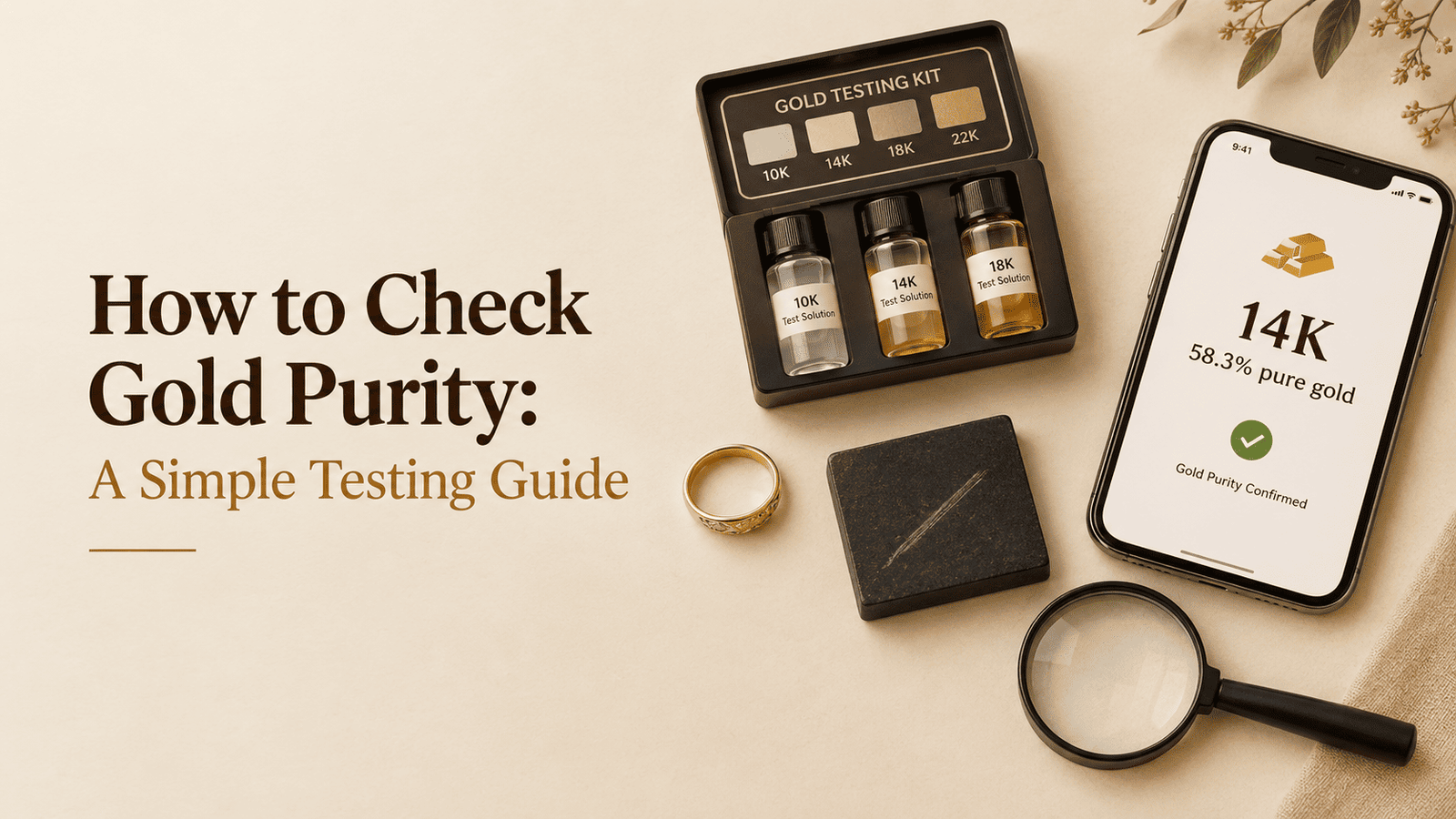
A typical gold testing kit guide covers a small set of tools: acid vials at different concentrations (usually marked for 10K, 14K, 18K, and 22K/24K thresholds), a testing stone for rubbing a sample streak, and sometimes a magnifying glass for inspecting the reaction closely. Kits are inexpensive and widely available, but they’re built for occasional home use, not the precision of professional equipment, and results depend heavily on following the included instructions carefully.
Professional Testing: X-Ray Fluorescence and the Karatmeter
For a definitive, non-destructive result, professional buyers and jewelers rely on X-ray fluorescence testing, often performed using a device called a Karatmeter. This instrument uses X-rays to give an exact purity reading in seconds, without scratching or otherwise damaging the piece, and it’s accurate enough that it’s used as part of official hallmarking certification in several countries.
XRF testing is the standard used at our valuation process, since it gives sellers a transparent, verifiable number without any risk to the item itself, whether it’s a modern piece or something older that needs a closer look under antique gold hallmarks conventions.
How to Check Gold Purity Before Selling
Anyone planning to sell gold benefits from checking purity themselves first, even informally, before getting a professional opinion. A quick home check using the magnet and visual tests helps set expectations, while a jeweler’s acid, electronic, or XRF test gives the number that actually determines an offer.
This matters just as much for scrap gold and broken pieces as it does for intact jewelry, since scrap gold prices are based entirely on confirmed metal content rather than condition or design. It also applies to coins and older pieces, since foreign or vintage stamps don’t always follow the same conventions as current US hallmarking, which is covered in more detail on the foreign gold hallmarks guide.
For a deeper look at how gold purity connects to buying and selling decisions more broadly, resources like this at-home testing walkthrough and this real vs fake breakdown cover additional angles worth reviewing.
Final Thoughts on How to Check Gold Purity
The magnet test, visual inspection and density comparison are good home tests and the acid test is a more reliable layer of confirmation for anyone willing to handle it carefully. If it is valuable, inherited or for sale, a professional XRF or electronic test is still the best and safest way to go. It answers the question without damaging the piece or leaving any doubt.
FAQ: How To Check Gold Purity
Q1: What’s the easiest way to check gold purity at home?
The magnet test is the simplest: real gold isn’t magnetic, so if a piece sticks to a magnet, it likely contains other metals.
Q2: What does the karat number on gold jewelry mean?
Karat measures purity on a 24-point scale; 24K is pure gold, while 18K means 18 out of 24 parts are gold, with the rest alloyed metals.
Q3: Is the acid test accurate for checking gold purity?
Yes, the acid test is one of the most reliable at-home methods, but it requires care since it involves a small scratch and corrosive chemicals.
Q4: Can jewelry stores test gold purity for free?
Many jewelers offer free or low-cost purity checks using acid testing kits or electronic testers as a courtesy to potential buyers or sellers.
Q5: What is the most accurate professional method to test gold?
X-ray fluorescence (XRF) testing, also called a Karatmeter, gives a precise, non-destructive purity reading in seconds.
Q6: Does a hallmark stamp guarantee real gold?
Not always stamps can be forged, so pairing a hallmark check with a physical test like acid or XRF gives a more reliable result.
Q7: Can I test gold purity without damaging my jewelry?
Yes, non-destructive methods like the magnet test, weight/density test, or XRF testing won’t harm your piece, unlike acid or scratch tests.