What Counts as Vintage Jewelry Little Rock Buyers Should Know
Vintage jewelry Little Rock collectors bring in ranges widely in age, style, and origin, and knowing what actually qualifies as “vintage” is the first step before buying, selling, or appraising a piece. In the jewelry trade, a piece is generally considered vintage once it is at least 20 years old, though many dealers use 50 years as the more common cutoff. Jewelry over 100 years old moves into the antique category. Anything in between, made roughly from the 1920s through the 1980s, falls under the vintage umbrella.
This distinction matters more than it seems. A ring from the 1990s and a brooch from the 1920s can both be called “vintage,” yet they represent completely different eras, materials, and values. Vintage jewelry Little Rock buyers who understand these date ranges are far better equipped to judge whether a piece is genuinely old, a later reproduction, or simply styled to look retro.
Antique jewelry, by contrast, must be at least a century old. Art Deco pieces from the early 1900s sit right on that border: some pieces are classified as vintage, others as antique, depending on the exact production year.
Popular Eras of Vintage Jewelry Little Rock Collectors Look For
Different design eras produced distinct looks, and vintage jewelry Little Rock shoppers often search for a specific period rather than “vintage” in general.
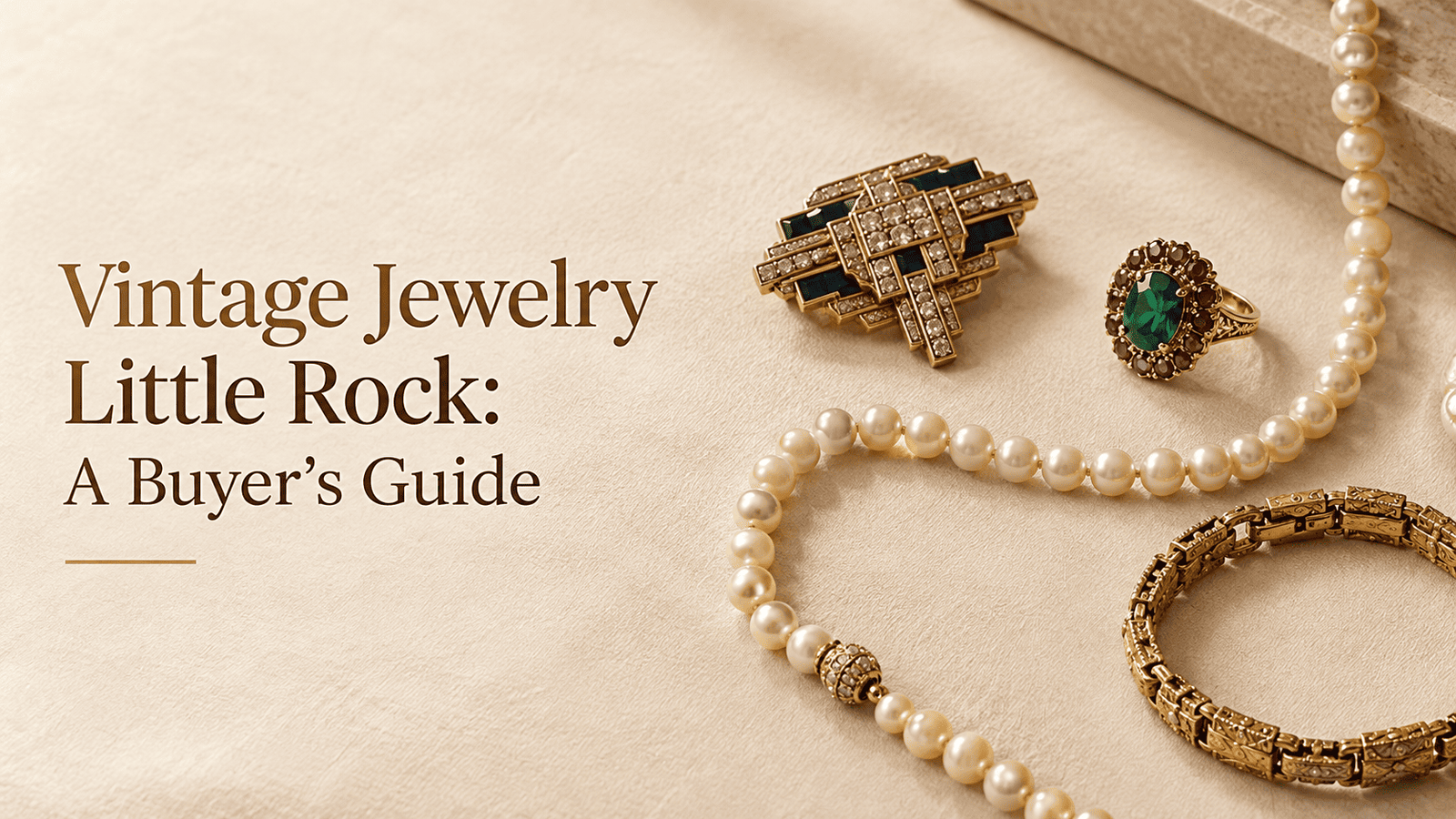
Art Deco (1920s – 1930s). Known for bold geometric shapes, symmetry, and contrasting colors. Art Deco was not just about jewelry; it also influenced architecture and design. Platinum settings, filigree work, and step-cut stones are common features of pieces from this period.
Retro (1940s – 1950s). Larger, bolder pieces made during and after wartime metal shortages, often in rose gold or yellow gold with chunky, sculptural designs.
Mid-Century (1950s – 1960s). Cleaner lines than Retro, with an emphasis on wearability. Mid-century jewelry Arkansas collectors seek out tends to blend classic craftsmanship with more modern silhouettes.
Costume Jewelry (1920s onward). Made with non-precious materials but often highly collectible depending on designer, condition, and rarity. Vintage costume jewelry value depends heavily on maker’s marks and design quality rather than metal content alone.
Art deco jewelry Little Rock buyers ask about most often includes rings, brooches, and cocktail pieces, since these were commonly produced in larger quantities during the era and survive in reasonable numbers today.
How to Date Vintage Jewelry Before You Sell or Buy
Knowing how to date vintage jewelry helps buyers avoid overpaying and helps sellers understand what they actually own. A few practical steps:
- Check hallmark stamps. Marks like 10K, 14K, 18K, 925, or Pt950 indicate metal purity and can sometimes be tied to a manufacturer or country of origin.
- Look at clasp and closure styles. Screw-back earrings, C-clasps on brooches, and box clasps on necklaces were common in earlier decades and largely phased out over time.
- Examine the settings. Hand-cut prongs, filigree work and irregularities in the metalwork are clues that the piece is the work of an older, pre-mass-production craftsman.
- Research maker’s marks. Designer signatures or maker stamps can significantly cut down the production time.
- Compare stone cuts. Old mine cuts and old European cuts predate the modern round brilliant cut and are a strong indicator of age.
A reliable way to learn how to date vintage jewelry in more depth is through dedicated collector resources. One practical collecting guide walks through common identifying features new collectors often miss.
Where to Sell Vintage Jewelry Arkansas Residents Trust
Sell vintage jewelry Arkansas sellers often start by researching value online, but the most accurate number comes from an in-person evaluation. A qualified buyer checks hallmark stamps, tests metal purity, and inspects craftsmanship and stone quality before making an offer, since vintage pieces can carry value beyond simple metal weight.
Vintage jewelry appraisal Little Rock sellers should expect a transparent process: the buyer examines the piece, explains what they’re seeing (metal type, approximate era, condition), and provides an offer based on both melt value and any collectible premium. See our valuation process for how appraisals are handled before any offer is made.
Estate vintage jewelry Little Rock sellers bring in most often includes inherited rings, brooches, and full jewelry boxes passed down through family. These collections frequently mix genuinely valuable vintage pieces with later costume jewelry, which is exactly why a professional evaluation matters. A buyer familiar with gold rings, gold bracelets, and gold necklaces across multiple eras can quickly separate what carries real value from what doesn’t.
Vintage Brooches and Rings Little Rock Buyers Look For
Vintage brooches and rings Little Rock collectors search for most fall into a few recognizable categories:
- Cocktail rings from the Retro era, typically large, colorful, and set in yellow or rose gold
- Floral and bow brooches popular from the 1940s through 1960s
- Signet rings with monograms or family crests, often passed down through generations
- Cluster rings combining multiple smaller stones, common in mid-century designs
Condition matters less than most people assume when it comes to metal and stone value, but original stones, intact prongs, and working clasps do add to a piece’s overall desirability for collectors specifically hunting for wearable vintage pieces rather than scrap.
For related pieces, gold earrings from the same eras are also commonly brought in alongside rings and brooches, since jewelry boxes rarely contain just one category.
Authentic Vintage Jewelry Near Me: Spotting Reproductions
Authentic vintage jewelry near me searches often turn up reproduction pieces styled to look old but manufactured recently. Some signs a piece may not be truly vintage:
- Hallmark stamps that are too crisp or use modern font styles
- Machine-perfect symmetry inconsistent with handmade construction from the era
- Clasp and closure hardware that doesn’t match the claimed production period
- Stone cuts that are clearly modern despite an “antique style” listing
One useful resource for spotting these inconsistencies is this collector’s blog, which covers common red flags buyers encounter when shopping secondhand and estate sales.
Retro Jewelry Near Me: Caring for Vintage Pieces at Home
Searches for retro jewelry near me often lead collectors to pieces that require a bit of TLC before wearing regularly. A few basic guidelines:
- Store pieces separately in soft pouches to prevent scratching between items
- Avoid harsh chemicals, including household cleaners and chlorine
- Clean gently with a soft cloth suited to the specific metal (gold, silver, or costume base metal)
- Have clasps and prongs checked periodically, since older mechanisms wear differently than modern ones
Proper storage extends the life of vintage pieces significantly, whether they’re being kept for personal wear or eventually sold. Additional care tips specific to costume and vintage pieces are covered in this collector resource and this newsletter on vintage costume jewelry.
Selling Damaged or Incomplete Vintage Jewelry Little Rock
Not every piece that comes in for evaluation is in wearable condition, and that’s expected. Vintage jewelry Little Rock buyers routinely purchase damaged, incomplete, or broken pieces, since gold and silver content retains value regardless of cosmetic condition. A cracked setting or missing stone doesn’t eliminate a piece’s metal value, though it may reduce collectible premium if the design itself was the main draw.
For gold-specific pieces missing stones or in poor repair, the underlying metal is still evaluated the same way as what we buy covers for any gold item, vintage or otherwise. Sellers should bring pieces in as-is rather than attempting repairs beforehand, since restoration costs rarely add proportional value to a melt-based offer.
Vintage Jewelry Little Rock: Final Thoughts
Vintage jewelry Little Rock buyers and sellers benefit most from understanding the basics before walking into any transaction: what actually counts as vintage versus antique, which eras carry the most collector interest, and how to spot a reproduction versus an authentic piece.
Whether the goal is selling your gold inherited jewelry, appraising a family collection, or simply learning more about a piece before deciding what to do with it, starting with accurate information avoids both underselling a valuable piece and overpaying for a reproduction.
A trusted local buyer familiar with hallmarks, metal purity, and era-specific craftsmanship remains the most reliable way to get an honest answer on any vintage piece.
FAQ: Vintage Jewelry Little Rock
Q1: What qualifies jewelry as “vintage”?
Jewelry is generally considered vintage once it is at least 20 years old, though many dealers use 50 years as the more common threshold. Anything older than 100 years is considered an antique.
Q2: How can I tell if my vintage jewelry is real gold or silver?
Check for hallmark stamps such as 14K, 18K or 925, but have a professional verify with acid testing or an electronic tester, as stamps alone are not always proof of authenticity.
Q3: Where can I sell vintage jewelry in Little Rock?
A local gold and silver buyer can appraise the hallmarks, metal purity and craftsmanship and offer a fair cash price for vintage and estate pieces.
Q4: Does vintage jewelry lose value over time?
Not normally. Vintage pieces from recognized periods like Art Deco are often rare and well preserved, so they tend to go up in value or at least maintain value due to scarcity and craftmanship, but it is contingent upon condition, demand and the piece itself.
Q5: What eras of jewelry tend to be most sought after?
“Art Deco, Victorian, and Art Nouveau are in high demand, but this is usually because they are unique and have historical significance, not necessarily because of the era they come from,” explains Meeks. “Condition, rarity and collector interest determine value more than the era.
Q6: Can damaged vintage jewelry still be sold?
Sure. If the design is not restorable, the piece will still have value according to the weight of the metal and the gemstones.
Q7: How do I care for vintage jewelry at home?
Separate the pieces to avoid scratching. Avoid harsh chemicals. Wipe gently with a soft cloth appropriate for the type of metal.